Sylvia Stone: So tell me a little bit about the show for people who aren’t familiar with The Thorn.
John Bolin: Okay, so The Thorn is basically a two-hour immersive, Cirque-style performance. I say Cirque because it’s really the closest thing to what we do. That tells the story of Jesus from the book of Genesis, so the creation, through the book of acts, so after he resurrected. It tells the story through dance, movement arts, martial arts, stunt performance, epic cinematic music, and huge visuals. It’s an immersive storytelling experience that just kind of exploded over the past few years across the country.
Sylvia: The very first performance of The Thorn was 30 years ago, which is wild, and I know you were talking about some of those Cirque elements. So tell me what you remember most about that very first performance and how it’s evolved over time.
John: Yeah. So, yeah, 30 years ago, my wife and I were in Colorado Springs. That’s where it started. And I was volunteering as like a youth director at a local church — working with high school and college students in my spare time. I’m not trained as a preacher but I’m a storyteller. I come from a very creative family. My parents were both performers and live stage actors. So instead of preaching, we would do what I called back then, like an illustrated dramatic storytelling type sermon.
There was one Wednesday night when I was sitting on the edge of the stage talking to a high school girl about 16 years old, and she sat down next to me and she just started bawling, and she held out her arms, and I could see where she’d been cutting on her arms, and it just broke my heart.
I looked at her and said, you don’t have to do that, because I believe that Jesus did that for you 2000 years ago. So I thought, you know what? Regardless of where these young people are coming from or even what their religious frame was, I wanted to do something that would show them they are seen and they’re deeply loved more than they could ever imagine.
And number two, I wanted them to know there’s a battle for their choices, their lives, their heart, their future. All those things. And so the next Wednesday night, we did the very first Thorn performance. And it was horrible. The makeup was bad, the lighting was bad, the costumes were bad. God bless those people. But the singers were horrible.
It wasn’t great. But there was something really special about that night, and there were a few hundred high school kids that felt like they were seen and they mattered, and that God loved them. And that was a really cool moment. And then the senior pastor of the church found out and said, hey, would you do this for our church for Easter?
Which kind of makes sense. And the first time we did it was actually October of 1996. So that was 30 years ago. And so then we said, sure, we’ll do it for the church for Easter. I didn’t know how to do that. So we just sort of figured it out and made it up. And it worked.
The next time we did it for the church at large. True story. There was a quarter mile of cars that couldn’t get into the church parking lot because people wanted to see the show so badly. And it took off like wildfire from there. And so for about ten years, we did it as like a typical big church Easter thing.
And we began to learn more about production and the dramatic arts. The first ten years or so, everyone was volunteers, so you can imagine what that was like. It was like herding cats. So there were people that were like dentists by day and then centurions by night, kind of a thing. That was the very beginning.
And then there was one time my wife and I went to Las Vegas and we saw Cirque for the first time. And I remember sitting in a Cirque show and being so emotionally moved by the production. And I thought, I wonder if we could use some of these same ideas in The Thorn. And so, that next Thorn season, we brought in some of the dramatic, the movement arts, acrobatics, and bigger dance. The Thorn really transformed after that first time seeing Cirque live in person. And now over the past 15 years, since then, 20 years since then, it’s grown and evolved. It’s now an independent theatrical production company. We tour with professional performers from all over the world, and as about 45 or so in our performance troupe, and they are amazing to watch. I mean, these are world-class athletes, some of them former Olympic athletes or Cirque performers or Broadway performers, and they’re all coming together to tell what we think is the greatest story of all.
Sylvia: I bet you never thought this is where that first performance would lead you.
John: Oh, not in a million years. Like we were just volunteering. And all of a sudden this thing grew bigger than us, and now it’s become our full-time thing. My wife Sarah and I, we do it together. She likes people a lot better than I do and so she’s the one who works with our cast and crew and hiring, and she’s amazing at that. And she’s actually the show there at the Orpheum in Omaha.
She will be the one on the platform. So representing our company. She opens the show. She speaks a little bit right before intermission. And so she’s amazing in that capacity. And I’m, I’m kind of behind the scenes making sure all the pieces are, are fitting together well, but it’s been a team effort for the last 30 years, and, boy, we didn’t see this coming. I’m telling you that.
Now, what happened was during Covid, we, we were dark, like everybody during the pandemic, you know, Broadway was dark and theater was dark around the country. And we thought The Thorn was over. And at that point, we’d only been touring to these big churches, you know, which has its own drama, to it, as you can imagine. At the end of Covid, we thought, I wonder if we could do one final Thorn tour. And, so I called all my friends that were pastors at these big churches, and I said, would you do the Thorn tour one more time? And they all said, maybe. Then they all said no, and for good reasons.
You know, they were all trying to recover from Covid. And so it wasn’t practical. So my wife and I had this idea, we thought, what if we took a major risk and we actually went into the public square to world-class performing arts centers like the Orpheum. And we brought this story to the public square.
Huge risk for us. We literally realized that if it didn’t work, we’d have to mortgage our house. That was the kind of risk it was. And it worked. And now, for the past three years, we’ve been touring across the country in amazing performing arts centers, in arenas. And the reviews have just been incredibly humbling.
Sylvia: And now the show is coming to the Orpheum and it’s been through Omaha before. But you’re actually from Omaha!
John: That’s right. I’m an Omaha boy. I’ve got my Husker gear back here on the shelf behind me. This is the year. We always say that right the first few games and I just hope we can do it. I’m a huge Husker fan.
But anyway, yeah, I grew up in North Omaha, near Benson High School, and my parents still live in the same house that I grew up in. They’re on Ellison Avenue, and, so, yeah, I’m a Nebraska boy through and through, for sure. When we first looked at Omaha —we’ve got an incredible promoter, Outback Presents — and when they first said a couple years ago, hey, what about Omaha, Nebraska? I thought, yes, that would be amazing. So it is a really sweet homecoming for us. I’ll be there. My wife will be there. Of course, my mom will be there with bells on, you know, all the things. But, we’re so excited to be back in Omaha.
Sylvia: Can you elaborate more on what it means to you? I mean, like you said, the show is really evolved and grown over the last 30 years, but to see something that you have poured so much of yourself and your wife has poured so much into to have come back to your hometown, that’s got to feel even more surreal.
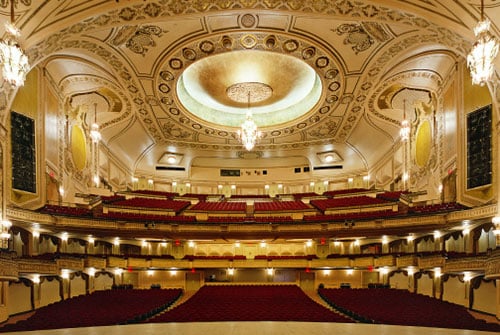
John: Honestly, it is. I have one. I just I’ll tell you a rabbit trail, I have one, like memory that’s blazed into my brain. I remember going to a show. It was a Christmas show with my family. December at the Orpheum. And I’ve got five siblings. So six kids in my family. And I remember sitting in the Orpheum Theater looking at the incredible ornate room and just thinking, “oh, this is so beautiful. It would be so amazing someday to do something in this room.” Really thinking that. But that was not even on my radar. I’m not really a performer at all. So I don’t even know how I was thinking that. But I remember thinking that. And that night, literally, I remember my parents somehow took all of their five kids and left me at the Orpheum. So I remember sitting in the lobby at the Orpheum. It was closing down. The janitors were shutting the doors. They put me out on the street like I was little Oliver Twist, you know, out on the street. Finally, my parents remembered, oh, wait a minute, there’s not six kids in the car. And they drove back and they picked me up.
But it is an incredible, beautiful homecoming for me. And it’s a full circle of, you know, these gifts and talents that have been around me and my family for all these years to see that coming back to my hometown with so many friends and my family there … there’s nothing like it. So it’s incredibly rewarding, incredibly beautiful, and, I can’t wait to be back there in downtown Omaha.
By the way, this is true. We have our cast and crews from all over the world. We’ve toured every major city in the US, and the last time we were in Omaha, something happened where it was like the three most perfect Omaha weather days you can imagine. And our team was staying downtown near the Old Market. And literally they said it was by far the best stop of any city on the tour that we’ve ever had. So not much to live up to Omaha, but our tour team thinks that Omaha is the best city in the country.
Sylvia: The Orpheum actually turns 100 next year, 2027.
John: What an anniversary! 100 years. That’s amazing. I mean, think of that, before either one of us were born that place was doing amazing shows, and it’s such an incredible venue with such a great story. So many amazing performers and the shows that have been through the Orpheum for the little Jesus show to play there and to be so well received. Honestly, it’s like a dream come true for me, for Sarah, for our team. We’re humbled. We’re excited. The venue, they’ve been so gracious. They welcomed us with open arms. They were incredible partners. Our performers felt loved and taken care of. The venue was beautiful. I mean, it’s a perfect Thorn venue. I’m excited to be there. We hope a bunch of our Omaha friends will show up and enjoy the show with us. I know it was an incredible run last time and we’re excited about coming back again this time.
Sylvia: I do want to talk a little bit about the show because like you said, the almost spectacle of it the and the ornate-ness of the Orpheum, there’s a lot of spectacle in The Thorn and with what the performers that are with the show are doing. When do you decide that spectacle serves the story versus is just spectacle, which I think stories of the Bible can really, you know, you talk about some of those miracles like it’s almost the perfect way to visualize it on stage.
John: It’s a great question, and it is something that our creative team is always sort of on this tightrope. There’s a scene in Indiana Jones and the Last Crusade, where Indiana Jones is in this cave with the knight, and he’s trying to pick which chalice is the right chalice of Jesus. And there’s the gold one. And then there’s this silver one, and there’s this beautiful one. And in the corner there’s this little wooden chalice.
And, the first guy that goes through it picks the wrong chalice, and he has a bad situation happen. Indiana Jones, of course picks the wooden chalice and the knight says, you have chosen wisely. So when you when you think of the story of Jesus, you don’t think of gold and ornate and all the things, right? You think of this, this manger or this cross or that he was an ordinary person like us in so many ways. That’s why he came like that. And so, so we’re always trying to make sure we tell the story that is human, that is real, that is authentic. But also from the very beginning, my heart was I wanted to show it in a way that would allow high school and college students in particular, to lean in, and I knew that to do that, we had to make sure we grabbed their attention.
I think it’s the greatest story of all time, there’s incredible story tools that we have to work with. And so we use them all. We do use spectacle. We use brilliant costumes. An amazing scene. I mean, you see people that watch The Thorn Act One, they’re laughing. Surprisingly, you wouldn’t think you’d laugh at the story of Jesus, his life and death and resurrection, but the narrator is played by a tremendous actor, Jim Miles. And our director, Andrew Harmon, has worked with Jim to create his monologues that are they’re heartbreaking. They are beautiful, and they’re hilarious in the first act. So act one, you’re laughing, you’re in awe. There’s we have this creation scene where the curtain drops and people are just in awe watching this. That’s not what they expect. That’s the one thing we hear over and over again when people walk out of the room is, wow, that is not what I expected. And that’s always our goal as storytellers, is to take the story that you’ve heard about a million times your whole life long, whether you like it or not. We all have some connection to the story, and we want to show it and tell it in a way that you’ve never thought or seen before.
That’s always our goal, to surprise the audience and have them think about the story in a different way. There is definitely spectacle. And I think the beauty of The Thorn, the backdrops, the scenic art. Oh, by the way, our scenic designer, Steve Williams, has been the dean of the theater department at UNO, and he’s brilliant scenic designer.
He’s been with us for about 20 years. My mom Via Bolin was actually our very first scenic designer. And, so she was up on ladders and all those things, and she was well into her 60s. So we have our scenic part of our show is very well rooted in Omaha, Nebraska, with Steve Williams and Via, my mom.
So I think I think the show matches the venue perfectly, like it feels like it belongs in this venue. When you watch it, it is beautiful to watch how everything just kind of all fits together, but we’re always trying to make sure that we keep it human because we don’t want people to say, oh, this story is just some fantastic fantasy. We want them to know that we believe this is real and authentic, but we want to show it in a way. Like stunts in the Bible, that doesn’t feel like it matches. You know, people on social media are like, what, the circus and Jesus, how does that work? But I’m telling you, it really does.
We treat the story of Jesus, his death and resurrection is treated with incredible reverence. It’s not a big circus at all. The show around it is is beautiful to watch. But that part is literally in the auditorium. And you’ll see this in Omaha. You can hear a pin drop during his death and resurrection. You can hear people weeping across the auditorium.
It’s a really powerful moment. And then of course, the resurrection. It just everyone goes bananas. It’s pretty awesome to watch that happen. So anyway, it takes you on a roller coaster through the whole show.
Sylvia: Is there a moment even after all this time that still gives you chills?
John: Oh, man, there’s so many now. They’re they truly are. If anybody should be numb to it, it should be me because I’ve seen it thousands of times. But certainly the resurrection moment. I think we do it in a way that’s surprising and different and unique. And when that moment happens, I think every time, it gets me, you know, there’s a moment and there’s a monologue in the second act when John the beloved to near the end of the show and he breaks the fourth wall, which is something unique in The Thorn, that doesn’t happen a lot in Broadway. So he’s addressing the audience like they’re there with him in his cave on Patmos, and he’s telling them his stories about Jesus. And then we watch the stories come alive on stage. But there’s just one moment when John the Beloved looks at the audience and he says: “he knows your name.” And I think there’s something, there’s something that gives you goosebumps.
Whether you believe in God or not, the fact that he believes in you and he sees you and you’re not just another name, a number, but he actually knows you and knows your name and cares about you. Like that’s a moment that always gets me. There’s a moment when he heals this little lame boy and our stunt performer does this incredible flip. You know, it’s a beautiful, fun moment that I always love. We have the baptism of Jesus that we’ve re-crafted over the last few years. And the way we do it now with the special effects is really fun. It’s really cool. It’s a great moment. So those are all special ones to me, but there’s so many, you know, little tent stakes throughout the show.
The goal is to have you watch the show and then to say “where at the time go? I could have watched this for another hour.”
Sylvia: I know this all started with a 16-year-old sitting next to you in a church in Colorado. What do you hope the people of Omaha that fill the Orpheum Theater leave with after seeing the show?
John: You know what’s great is The Thorn attracts Protestants and Catholics, believers, nonbelievers, atheists, agnostics across the board, people of every different denomination, every different stripe because they are curious. And I’ve got so many reviews that I could read you of people that have no church connection, that don’t know what to say afterwards.
I remember being in New York City one time with my wife in Newark and this, this very like, well put together New York looking guy ran up to my wife and just started bawling and said, I don’t believe in God. I don’t believe in Jesus. But I’ve never seen anything so beautiful. And I’m going to think about this story for a long time.
That’s the goal for us as storytellers. We don’t want to tell people what to think. We just want to lay it out there. So what I hope they leave with is I hope they’re wildly entertained and they have a wonderful time with their family and friends. But more than anything, I want them to know they are seen and they are loved no matter where they are, no matter what they’ve done, no matter what their story is, they are seen and they are loved.
And that’s the central story of The Thorn. That God knows your name. That sounds cheesy, kind of religious, but honestly, our team is not like that. Our team is a wild bunch and they just love coming together, using their incredible gifts and talents to tell this story.
And the other thing is that there’s more to life than meets the eye. We tell the story of Jesus, but we also pull back the veil between our world and the supernatural. So you see angels and demons battling it out like you don’t typically imagine that in a church or in a theatrical production like this, but The Thorn has a lot of that and it’s fun to watch.
Sylvia: John, thank you so much for talking to me today, and we are so excited to have The Thorn come through September 29 and 30 to the Orpheum.
John: Thank you, Sylvia. It’s such a joy. I can’t wait to come back home again. And, any more information if you want to dig deeper into the story, the thorn.com gives you all the details or some videos to watch and some backstory, and we can’t wait to be there with you. Be back in Omaha at my old stomping grounds. I’m just hoping between now and then, the Huskers can win every game so that everybody’s excited and feels good walking into the show. So go Big Red.
Sylvia: Is there anywhere that you’re going to stop by or anything you’re excited to see when you’re back in town?
John: Oh man. Everything. Honestly, The Riverfront and Downtown is constantly changing. My brother lives there, who also does all of our graphics and video work. Luke Bolin, he’s an awesome video designer. But anyway, I’ll go back and I want to see Old Market/Riverfront area and kind of walk through downtown. That’s probably what I’m most excited about. And then and then just to be in the Orpheum and, and take it all in with, with family and friends.